The PPWR at a glance
What is the PPWR?
The Packaging and Packaging Waste Regulation (PPWR), the new European Packaging Regulation, defines the legal framework for packaging and packaging waste within the EU. The Regulation came out of the European Green Deal and the Circular Economy Action Plan. The PPWR creates uniform EU-wide standards that are binding for all Member States.
What does PPWR stand for?
PPWR stands for Packaging and Packaging Waste Regulation.
The full and official English title is Regulation (EU) 2025/40 of the European Parliament and of the Council of 19 December 2024 on packaging and packaging waste, amending Regulation (EU) 2019/1020 and Directive (EU) 2019/904, and repealing Directive 94/62/EC (Text with EEA relevance). To abbreviate this unwieldy title, the law is commonly known as the EU Packaging Regulation, the European Packaging Regulation, PPWR or PPWR Regulation.
What are the objectives of the PPWR Regulation?
The PPWR’s key goal is to minimise the consumption of resources and the environmental impact of packaging waste in the EU in two ways:
- Firstly, by reducing the amount of packaging material used,
- and secondly, by ensuring that packaging is recyclable, reducing the share of non-recyclable packaging waste.
- In addition, substances of concern in packaging material are to be minimised.
What’s new compared with the current EU Packaging Directive?
A main difference between the new and the old Directive is that the new Directive contains stricter requirements for recycling rates and material utilisation. This means that, by 2030, packaging must be designed to be recyclable. Also, a mandatory minimum percentage share of recycled material in packaging will be applicable. What’s more, the new Packaging Directive introduces comprehensive documentation obligations: From 12 August 2026, in order to comply with the packaging law, every item of packaging must come with a comprehensive self-declaration, i.e. declaration of conformity. This requires technical documentation to be prepared in advance, including a description of the packaging and its purpose.
As a European Regulation, the PPWR applies directly in all Member States, meaning that it does not have to be translated into national law. This is where it differs from the EU Packaging Directive 94/62/EC, which it replaces.
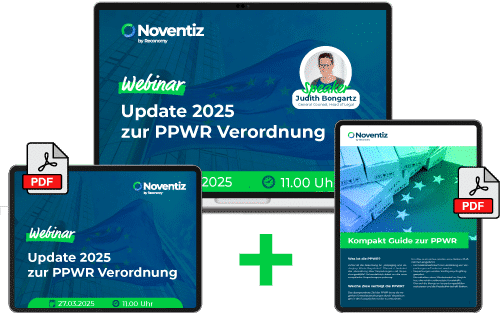
PPWR information pack (in German)
For detailed information on the key operators and requirements of the PPWR, ask for our free PPWR Infopaket (in German). It contains access to the recording of our latest PPWR webinar, the webinar presentation and a compact guide.
To whom does the PPWR apply?
Article 3 of the Regulation defines the various operators affected by the PPWR. Their obligations depend on their roles.
Who is affected by the PPWR?

Manufacturers
Any natural or legal person that manufactures packaging or a packaged product (with the exception of own brands and micro-enterprises).

Producers
- Anyone that places transport packaging, service packaging or primary production packaging on the market
- Makes products available for the first time that are packaged in packaging other than the aforementioned packaging (primarily sales and grouped packaging)
- Distributes packaging directly to end users
- Unpacks packaged products without being an end user

Importer
Any natural or legal person established within the Union that places packaging from a third country on the market.
Distributor or dealer
Any natural or legal person in the supply chain, other than the manufacturer or importer, that makes packaging available on the market.

Supplier
Any natural or legal person that supplies packaging or packaging material to a manufacturer.
PPWR Newsletter
Sign up for our free PPWR Newsletter for the latest information on PPWR updates, invitations to our PPWR webinars and more.
Key requirements under the PPWR at a glance
The PPWR requirements can be summarised as follows:
- Restriction of hazardous substances
- Recyclability of packaging
- Minimum recycled content in plastic packaging
- Packaging minimisation to the absolute minimum
- Labelling of packaging
- Ban on certain packaging formats and deceptive packaging
- Reduction of single-use packaging
- Increased use of reusable packaging
- Appointment of an authorised representative
- Preparation of declarations of conformity
For more detailed information, please read the following summary of the most important articles of the PPWR.
Only
days to go – the PPWR is coming!
Find out more about our PPWR Consulting Workshop
PPWR: What exactly do initial distributors need to do?
To meet the obligations of the Packaging Act with regard to packaging that is subject to mandatory participation, producing companies, importers, retailers, mail-order companies and online retailers must comply with the following points:
Article 5: Limits for substances of concern in packaging
In order to protect the environment and health, the PPWR sets strict limits for hazardous substances in packaging. Packaging must be manufactured in such a way that the presence and concentration of substances of concern as constituents of the packaging material or of any of the packaging components is minimised.
Certain chemicals that are considered to be of most concern – such as heavy metals or perfluorinated and polyfluorinated alkyl substances (PFAS) – are either to be banned completely or their concentration is to be severely restricted. Producers must ensure that their packaging is free of these substances, or only contains permissible levels so as not to jeopardise recyclability and circularity. Compliance with these requirements must be verified in the technical documentation as part of the conformity assessment.
Article 6: Recyclability of packaging
In future, all packaging placed on the market must be recyclable and will be categorised into performance grades A, B or C. The following two requirements will help to define recyclability more precisely.
- From 2030: Design for Recycling (DfR): DfR means that packaging is designed for material recycling, meaning that the secondary raw materials produced in the recycling process are of sufficient quality to substitute primary raw materials.
- From 2035: Recycled at Scale (RaS): This requirement must be fulfilled in addition to Design for Recycling. It means that packaging waste can be collected separately, sorted and recycled using well-established or already effective methods. In addition, the annual quantity of recycled material must be equal or greater than 55% of the total packaging material.
Compliance with the requirements under Art. 6 (2) and (3) of the PPWR must also be demonstrated in the technical documentation that forms part of the conformity assessment.
Prüfen Sie schon jetzt die Recyclingfähigkeit Ihrer Verpackungen mit unserem Bewertungsverfahren rotate.
Article 7: Minimum recycled content in plastic packaging
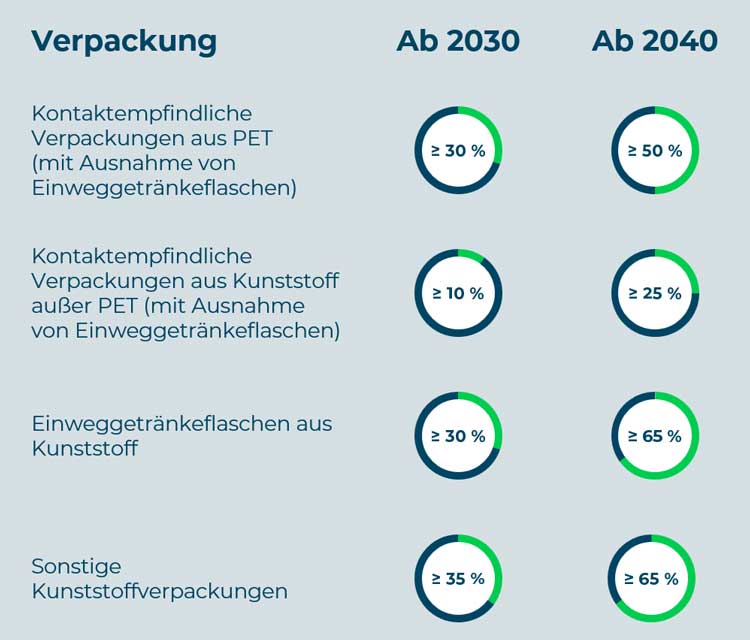
In order to increase the demand for recycled plastic and reduce the use of primary raw materials, the PPWR Regulation stipulates binding minimum recycled content in plastic packaging recovered from post-consumer plastic waste. From 2030, packaging must contain a specified proportion of recycled plastic, with this rate being gradually increased. This is to ensure that more plastics are kept in the cycle and fewer new raw materials are used.
Article 8: Biobased feedstock in plastic packaging
The PPWR defines biobased plastics as plastics made from biological resources, such as biomass feedstock, organic waste or by-products, irrespective of whether these plastics are biodegradable or non-biodegradable. By 12 February 2028, the Commission will review the status of technical development and the environmental compatibility of biobased plastic packaging. It may develop a legislative proposal on the basis of the review. Currently, Art. 8 of the PPWR does not yet establish any independent obligations.
Article 9: Compostable packaging
From 12 February 2028, the following packaging must be compostable:
- permeable tea, coffee or
- other beverage bags
- soft after-use system single-serve units that contain tea, coffee or another beverage
- or another beverage, and which are intended to be used and disposed of together with the product
- sticky labels affixed to fruit and vegetables
Article 10: Packaging minimisation
One of the key demands of the PPWR is avoiding packaging where it is not needed. In future, companies will have to verify that the size and material used for their packaging has been reduced to the necessary minimum. With the introduction of the new law, only packaging whose weight and volume have been reduced to the minimum necessary to ensure its functionality may be placed on the market. This particularly applies to oversized packaging or multiple packaging that does not offer any functional added value. Deceptive packaging, i.e. packaging which makes the product volume appear larger than it actually is, e.g. by using a double base, will also no longer be permitted. The aim is to reduce the amount of material and waste without compromising the protective function of the packaging.

Article 11: Reusable packaging
The Commission has defined a set of requirements specifying eleven characteristics of reusable packaging. These include being designed to be emptied, unloaded, refilled or reloaded without being damaged as well as meeting consumer health, safety and hygiene requirements. They must be able to complete as many rotations as possible and be recycled at the end of their life. Compliance with these requirements must be verified in the technical documentation as part of the conformity assessment.
By 12 February 2027, the EU Commission will adopt a delegated act establishing a minimum number for the rotations for certain packaging formats.
Article 12: Labelling obligation
Packaging and waste receptacles will have to be marked with a harmonised label to facilitate proper disposal and recycling. The label is intended to support both consumers and disposal companies by providing clear information on the material composition and proper disposal of the packaging. The intention is to use clear, standardised symbols throughout the EU.
The specific form of the labelling obligation will be established in further implementing acts, to be adopted by 12 August 2026. The labelling obligation will then apply from 12 August 2028, or no later than 24 months from the date of the adoption of the implementing act. There is a transitional period of up to three years during which unlabelled packaging that was manufactured in the EU or imported into the Union before the labelling obligation came into force may be sold.
Article 15: Manufacturers’ obligations
Manufacturers may only place packaging on the market which is in conformity with the requirements of Articles 5 to 12. Before placing packaging on the market, manufacturers must carry out the conformity assessment procedure referred to in Article 38. In addition, technical documentation is required, which is referred to in Annex VII. If the packaging complies with the requirements, manufacturers must draw up an EU declaration of conformity (see Article 39).
Manufacturers are also subject to a labelling obligation and have to ensure that the packaging bears a type, batch or serial number or other elements allowing its identification. Where the size or nature of the packaging does not so allow, the required information must be provided in a document accompanying the packaged product.
Article 15 also stipulates that manufacturers must indicate their name, registered trade name and postal address on the packaging or via a QR code (or other data carrier). If available, an e‑mail address or other digital contact options should also be provided. If such information cannot be affixed to the packaging, the packaging, or an enclosed product information sheet, must bear a QR code or other standardised, open, digital data carrier that provides such information. The postal address provided should include a single point at which the producer can be contacted.
These obligations apply from 12 August 2026.
Article 24: Rules about empty space
The PPWR also aims to minimise unnecessary empty space in packaging. Shipping packaging is often larger than necessary, especially in online retail. Empty space is the space filled by filling materials, such as air cushions, foam fillers or paper. The new rule stipulates that this empty space must be reduced to the minimum necessary in order to reduce resource consumption and CO₂ emissions during transport.
From 2030 onwards: For grouped packaging, transport packaging and e‑commerce packaging (shipping packaging), the empty space ratio should not exceed 50%. The obligation does not apply to reusable packaging.
Article 25: Restriction of certain packaging formats
Certain packaging formats that are considered particularly harmful to the environment are to be restricted or banned under the PPWR. This includes, for example, plastic single-use packaging for immediate consumption or combinations of materials that are difficult to recycle. The aim is to eliminate unnecessary packaging and encourage companies to use more sustainable alternatives. However, Member States can exempt micro-enterprises from this ban if it has been proven that it is not technically feasible.
Article 39: Declaration of conformity
In future, companies that place packaging on the market will have to draw up a declaration of conformity for each item of packaging. This self-declaration states that the packaging used has been demonstrated to fulfil the requirements of Art. 5 to 12 of the PPWR, and that all required standards are complied with. Producers and dealers are obliged to keep this supporting evidence and to present it to the authorities if required. From 12 August 2026, the declaration of conformity will be mandatory for every type of packaging.
Article 43: Prevention of packaging waste
The PPWR Regulation sets clear targets for reducing packaging waste and requires each Member State to reduce the amount of packaging waste generated per capita. The EU has set specific reduction targets for this over the coming decades. The year 2018 is used as a reference point.
- By 2030: Reduction in packaging waste by 5% compared to 2018.
- By 2035: Reduction in packaging waste by 10% compared to 2018.
- By 2040: Reduction in packaging waste by 15% compared to 2018.
Authorised representation
Companies that place packaging on the market in several EU countries will need an authorised representative in those Member States in which they are not established. The authorised representative assumes responsibility for compliance with the PPWR requirements in the respective countries and serves as a central point of contact for authorities. This is an important provision to ensure compliance, especially for internationally operating companies.
Feeling overwhelmed by the specific requirements of the PPWR?
You are not alone – many companies feel the same way. In order to provide our clients with the best possible support, we have developed our new Eco-Check (Environmental Compliance Check) service, a consulting workshop. We will come to you to help you create a tailored action plan for implementing the PPWR requirements.
Schedule and deadlines of the PPWR
When does the PPWR come into force?
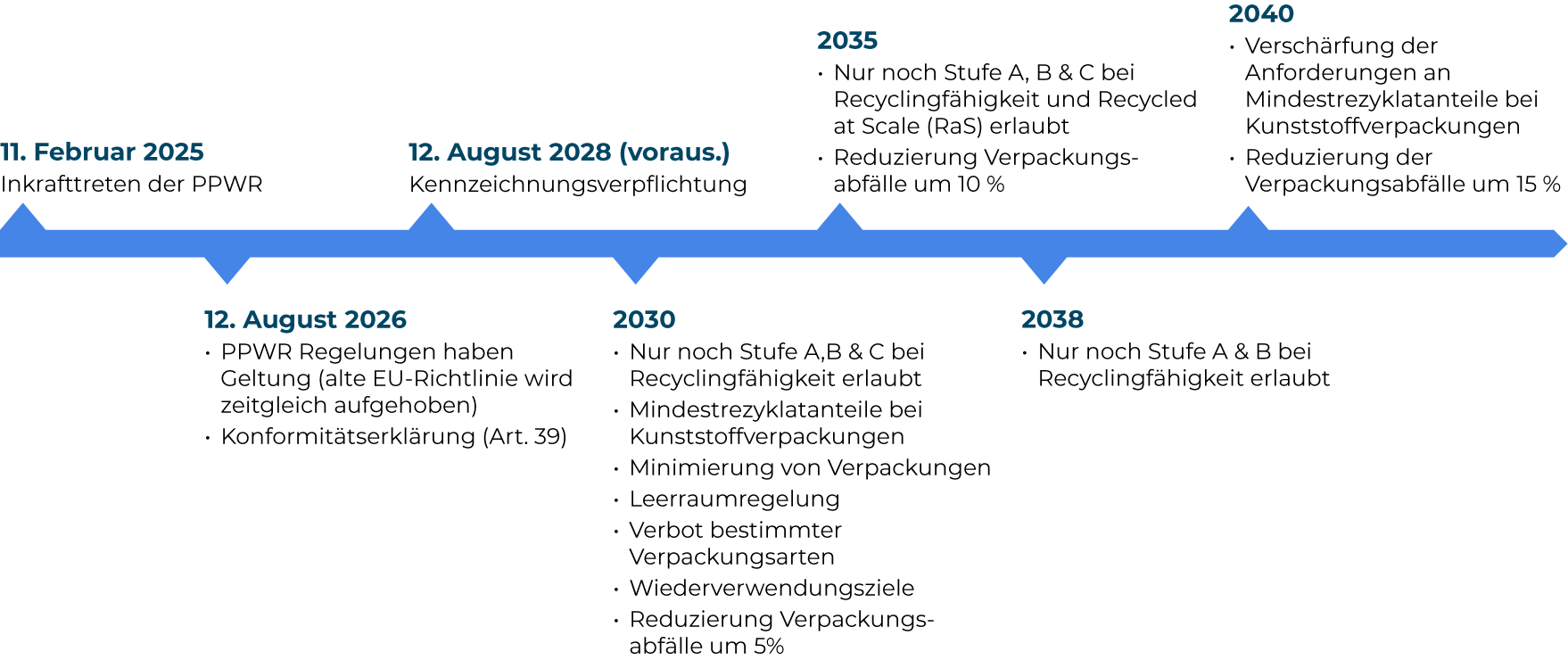
The EU Packaging Regulation (PPWR) was published in the Official Journal of the European Union on 22 January 2025 and officially entered into force on 11 February 2025. The next step is a transitional period lasting 18 months, until 12 August 2026, by which date full compliance is required across all EU Member States. That being said, not all PPWR regulations must be fulfilled immediately – some will be introduced incrementally.
PPWR timeline: Key deadlines at a glance
What happens if the PPWR is breached?
Packaging that does not meet the stipulations of the EU Packaging Regulation may no longer be placed on the market within the EU and faces the risk of fines and loss of sales due to an immediate sales ban. Another serious potential consequence of not meeting the requirements is a considerable loss of reputation. The extent of the fines is not yet known and must be set by the German parliament by 12 February 2027. As the fines are each Member State’s own responsibility, they may vary between countries.
Next steps: What should companies do now?
- Check your role: Who am I? (Producer, manufacturer, …)
- Define the responsibilities associated with your role: Which actions do you have to take, and by when?
- Prepare the declarations of conformity: What information do you need, and who can give it to you?
- Monitor upcoming developments related to the PPWR: Are you up to date?
Our webinar series on the PPWR and environmental regulations (in German)
Webinar-Aufzeichnung
PPWR compliance: How we can help
Many companies feel overwhelmed by the requirements of the PPWR. To help businesses stay in control, we offer a range of services, including our Eco-Check Workshop, which is specifically tailored to the PPWR:
Eco-Check: PPWR Consulting Workshop
Our Eco-Check (Environmental Compliance Check) Consulting Workshop has been designed to support companies implement the latest PPWR requirements. We will come to you to help you create a tailored action plan for implementing the PPWR stipulations.
Design for Recycling: Analysing recyclability with rotate
Another service helping you manage PPWR requirements is our ‘rotate’ service, which provides packaging analysis and optimisation. We will help you identify any potential for optimisation and check the recyclability of your packaging. Where necessary, we will recommend adjustments so that you can be sure to comply with the new legal stipulations of the EU Packaging Regulation.
EU service: Comply with Europe-wide requirements
Producers who place packaging or packaged products on the market in various EU countries will have to fulfil the respective national requirements as well as the harmonised requirements under the EU Packaging Regulation. These include, for example, the obligation to register with the register of producers of the respective country, to report packaging volumes, and to participate in a producer responsibility organisation (PRO).
Our EU services can assist you in various ways: It will inform you about the requirements in each country of interest, and it will provide support with meeting them, e.g. by managing registrations for you.
Blog posts on the PPWR and environmental regulations:

FAQs: PPWR in brief
When does the PPWR Regulation come into force?
The PPWR Regulation officially came into force on 11 February 2025. After the end of the transitional period of 18 months, on 12 August 2026, the first set of requirements apply.
What does the EU Packaging Regulation (PPWR) say?
The EU Packaging Regulation (PPWR) aims to reduce packaging waste within the European Union, and to promote a circular economy. It specifies requirements for the recyclability, use, manufacture, labelling and disposal of packaging. This includes improving the recyclability of packaging, increasing the proportion of recycled content in packaging and reducing packaging waste.
What type of packaging does the PPWR apply to?
The PPWR applies to all packaging, regardless of the material used. It also applies to all packaging waste, regardless of whether this packaging is used in industry, in other manufacturing, retail or distribution companies, in administration, in the service sector or in households, or whether this packaging waste is generated there.
Who does the PPWR apply to?
It applies to almost all economic operators, from manufacturers and importers to producers and fulfilment service providers.
Which companies are affected by the PPWR?
In future, it will apply to all companies based in the EU and to companies that import packaging into the EU.
Does the PPWR also apply to online retailers?
Yes, the PPWR Regulation also applies to online retailers. Like all other companies, online retailers must also ensure that their packaging complies with the requirements of the EU Packaging Regulation. These include requirements for the recyclability of packaging, the reduction of packaging volume and limits for empty space in shipping packaging.
What are the consequences/sanctions for non-compliance with the PPWR?
Packaging that does not meet the stipulations of the PPWR Regulation may no longer be placed on the market within the EU. Any breach may result in fines and loss of sales as well as possible damage to the company’s image.
How does Noventiz help businesses to implement the PPWR?
Noventiz is your reliable partner for meeting these new legal challenges. We have developed Eco-Check, rotate and the EU service to cover various aspects of the PPWR requirements. Please drop us a line by using our Contact form. We look forward to discussing your specific needs in a personal consultation.