Article 5 of the PPWR: PFAS limit values and substance requirements for packaging
With the European Packaging and Packaging Waste Regulation (PPWR), the EU is significantly tightening the requirements for packaging. A key element of the regulation is Article 5 PPWR, which governs the restriction of so‑called substances of concern. Particular attention is paid to PFAS (per‑ and polyfluorinated alkyl substances) in food contact packaging.
The new requirements will apply directly in all EU Member States from 12 August 2026. For manufacturers, importers and brand owners, this means immediate need for action with regard to material compositions, supply chains and technical documentation.
What does Article 5 of the PPWR regulate with regard to substances of concern?
Article 5 follows a two‑step approach.
General minimisation obligation
First, the PPWR requires that packaging be manufactured in such a way that the presence and concentration of substances of concern in packaging materials and packaging components are reduced to a minimum.
This obligation is deliberately broad and applies to all substances that
- may pose a risk to human health, or
- may impair recycling processes and material cycles.
Specific limit values for certain substances
In addition, Article 5 sets binding limit values for selected substance groups, including:
- the four heavy metals lead, cadmium, mercury and hexavalent chromium
- PFAS in food contact packaging, often referred to as “forever chemicals”
PFAS are a large group of synthetic chemicals with grease‑, water‑ or dirt‑repellent properties and are characterised by their high environmental persistence. The aim of the PPWR is to reduce their negative impacts on human health, the environment and recyclability.
Specific limit values under Article 5 of the PPWR
Heavy metals
The combined total of lead, cadmium, mercury and hexavalent chromium must not exceed 100 mg/kg.
This limit applies to all packaging, regardless of its intended use.
PFAS in Lebensmittelkontaktverpackungen
From 12 August 2026, food contact packaging may no longer be placed on the market if it reaches or exceeds the following limit values:
- 25 ppb for individual PFAS (targeted analysis; polymeric PFAS excluded)
- 250 ppb for the sum of PFAS (sum of targeted analyses; polymeric PFAS excluded)
- 50 ppm for PFAS including polymeric PFAS
Important for practical implementation: marketability depends solely on the verified concentration. No distinction is made as to whether PFAS were intentionally added or unintentionally present.
Additional requirement in the case of elevated total fluorine
If the total fluorine content of packaging exceeds 50 mg/kg, manufacturers or importers must, upon request, be able to demonstrate what proportion of the fluorine is attributable to PFAS and what proportion to non‑PFAS substances.
FAQ: Frequently asked questions on the restriction of substances of concern
Who is responsible for packaging compliance and proof?
Under the PPWR, the manufacturer is responsible for packaging compliance. A manufacturer is any economic operator who:
- manufactures packaging or packaged products, or
- has them designed or manufactured under its own name or trademark, and
- places them on the EU market for the first time.
This particularly includes:
- brand owners
- retailers with private labels
- importers (in the case of imports from third countries)
Important: online retailers may also fall under the manufacturer’s responsibility.
Are there any quantity thresholds or de minimis limits?
No. Article 5 of the PPWR does not provide for any quantity thresholds.
As soon as packaging is placed on the market, the limit values must be complied with – regardless of company size or number of units.
How can it be determined whether packaging contains PFAS?
PFAS are typically used where grease‑, water‑ or dirt‑repellent properties are required, for example in coated paper or cardboard packaging.
However, whether packaging contains PFAS can only be reliably determined through:
- supplier and material declarations, and
- targeted laboratory analyses (e.g. PFAS analysis or total fluorine screening).
May PFAS‑containing packaging manufactured before 12 August 2026 still be used?
No. The decisive factor is the date of placing on the market, not the date of manufacture.
From the date of application of the PPWR, no food contact packaging may be placed on the market if it exceeds the new PFAS limit values.
Packaging that was already lawfully placed on the market before this date does not have to be withdrawn.
Practical guidance: What companies should do now
The requirements of Article 5 of the PPWR apply to all companies that place packaging on the EU market for the first time. Packaging suppliers and material manufacturers are also indirectly affected, as they must provide appropriate evidence.
Recommended measures:
- Review and secure compliance with limit values: Ensure that heavy metal and PFAS limit values are met – where necessary through laboratory testing.
- Prepare technical documentation: Compliance with the requirements must be documented in a transparent and traceable manner.
- Integrate suppliers: Contractually anchor PFAS and heavy metal requirements in specifications and purchasing conditions.
- Assess risks at an early stage: In the case of complex supply chains or uncertainties, a structured risk analysis is recommended.
Conclusion: Act early to ensure legal certainty
The new packaging requirements, including binding limit values, will apply from 12 August 2026. There is no transitional period.
Companies should now:
- analyse material flows
- assess PFAS risks
- secure supply chains
- adapt internal testing and verification processes
Those who act early will not only ensure regulatory compliance, but also make an important contribution to sustainable, low‑pollutant packaging cycles.
Contact our PPWR team – we will make you PPWR-ready, e.g. in the Noventiz Eco-Check workshop.
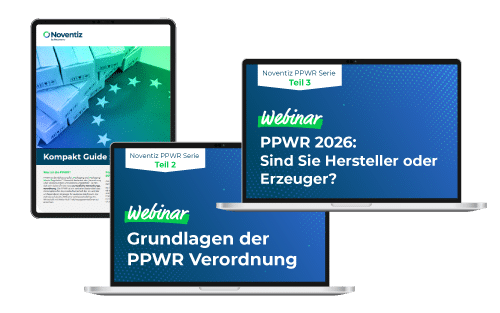
Zwei Webinare (Aufzeichnung & Präsentation):
- PPWR‑Grundlagen‑Webinar
- Abgrenzung Hersteller & Erzeuger
+ zusätzliches PPWR Kompakt PDF
Erfüllen Sie auch die PPWR Vorgaben in Punkto Recyclingfähigkeit
Die Recyclingfähigkeit von Verpackungen spielt eine zentrale Rolle in der PPWR-Verordnung. Diese fordert ab 2030 recycelbare Verpackungen mit steigendem Rezyklatanteil. Unternehmen sollten deshalb bereits jetzt ihr Verpackungsdesign optimieren, um gesetzliche Vorgaben zu erfüllen und die Kreislaufwirtschaft zu stärken.
Weitere Informationen:
Auf dem Laufenden bleiben mit Noventiz
Bei Noventiz unterstützen wir Unternehmen Deutschland- und europaweit in allen Fragen zur Umwelt-Compliance. Haben Sie Fragen zu unseren EPR-Leistungen?