PPWR at a glance: Support for businesses
Noventiz’s PPWR Knowledge World brings together a wide range of information and resources, such as guides, checklists and videos, to help businesses comply with PPWR requirements. As your trusted partner in environmental compliance, we offer various solutions to help you meet the requirements of the PPWR:
Content
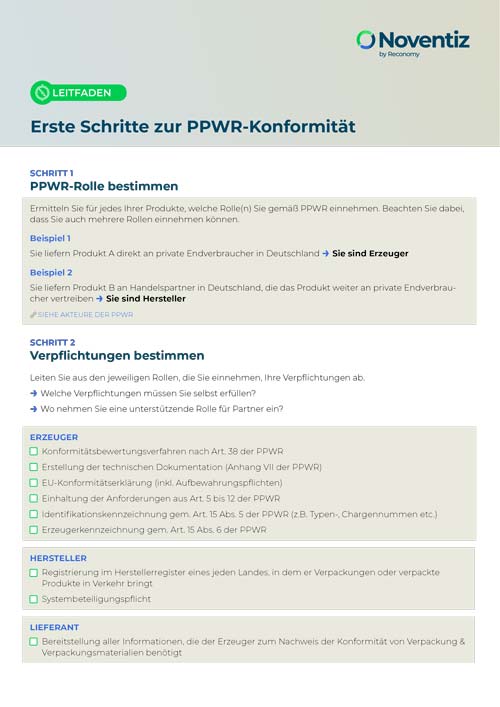
First steps towards PPWR conformity
Are you just starting out with your PPWR compliance and not sure where to begin? Our free guide helps you navigate the PPWR and takes you through the first steps towards PPWR compliance.
What is the PPWR?
The Packaging and Packaging Waste Regulation (PPWR) is the European Packaging Regulation. It defines the legal framework for packaging and packaging waste within the EU and creates uniform standards that are binding for all EU Member States. The PPWR aims to reduce the environmental impact caused by packaging waste.
Who is affected by the PPWR?
The PPWR redefines legal roles and operators. Their legal obligations depend on their roles. However, the complexity and scope of the legal requirements vary considerably. Furthermore, a company may fulfil several legal roles at the same time, depending on the circumstances, and therefore need to comply with a wide range of requirements.
Manufacturer
According to the PPWR, a manufacturer is the natural or legal person that has packaging or a packaged product developed or manufactured under its own name or trademark.

Producers
Under the PPWR, a producer is any manufacturer, importer or distributor to whom one of the following applies:
- anyone that places transport packaging, service packaging or primary production packaging on the market
- makes products available for the first time that are packaged in packaging other than the aforementioned packaging (primarily sales and grouped packaging)
- distributes packaging directly to end users
- unpacks packaged products without being an end user
Importer
Any natural or legal person established within the EU that places packaging from a third country on the market.[1]
[1]Use the PPWR wording “within the Union”.
Distributor or dealer
Any natural or legal person in the supply chain, other than the manufacturer or importer, that makes packaging available on the market.

Supplier
Any natural or legal person that supplies packaging or packaging material to a manufacturer.
Who is the manufacturer under the PPWR?
Infografik
Step-by-step guide to determining the manufacturer
VIDEO
Praxisnahe Beispiele zur Bestimmung der Erzeuger/Hersteller Rolle
Watch the video in which Noventiz legal expert Judith Bongartz uses practical examples to illustrate who is categorised manufacturer in which case.
Producer or manufacturer?
Take the PPWR quiz to test your knowledge
Die Unterscheidung zwischen Hersteller und Erzeuger ist oft besonders herausfordernd. Können Sie in den folgenden Beispielen den richtigen Erzeuger bestimmen?
What legal obligations does the PPWR impose?
The EU Packaging Regulation describes the various operators according to a tiered system of responsibility, in which producers and manufacturers have the greatest obligations. In legal terms, producers and manufacturers are two separate economic operators, each with their own definition and their own obligations.
Manufacturer
- Conformity of packaging pursuant to Art. 5 to 12 of the PPWR
- Declaration of Conformity incl. assessment procedure, technical documentation and retention obligations
- Identification labelling (e.g. type numbers, batch numbers, etc.)
- Manufacturer identification (name, address, etc., possibly as a QR code)
Producers
- Registration obligation (in Germany: LUCID Packaging Register)
- Mandatory participation
- Obligation to report packaging volume
- Where necessary Authorised representation
Importer
- Only compliant packaging may be placed on the market
- Indication of name, registered trade name or trademark, postal address and, if required, electronic means of communication
- If a packaging is found to be non-compliant, it must not be made available on the market.
- Provision of a Declaration of Conformity
Distributor
- Verification requirements (e.g. whether the producer is listed in the register of producers, labelling in accordance with Article 12 of the PPWR, manufacturer’s or importer’s compliance with the obligation to provide information)
- If a packaging is found to be non-compliant, it must not be made available on the market, and the information must be transmitted to the market surveillance authority
Supplier
- Provision of all information and documentation required by the manufacturer to demonstrate the conformity of the packaging and packaging materials.
What specific measures must producers and manufacturers take under the PPWR?
Download our comprehensive checklist of producers and manufacturers’ obligations here.
Checkliste
Are you a producer under the PPWR?
Checkliste
Are you a manufacturer under the PPWR?
PPWR stipulations at a glance
What exactly does the European Packaging Regulation actually say, and what requirements does the PPWR set out? Below is a brief summary of the key legal stipulations set out in the PPWR:
Article 5: Limits for substances of concern
Packaging must be manufactured in such a way that the presence and concentration of substances of concern (e.g. lead, cadmium, mercury, PFAS) as constituents of the packaging material or of any of the packaging components is minimised.
Article 6: Recyclability of packaging
All packaging placed on the market must be recyclable. To this end, minimum requirements (recyclability performance grades) are defined. Implementation will take place in two stages, which will come into effect from 2030 and from 2035 respectively.
Article 7: Minimum recycled content in plastic packaging
From 2030, packaging must contain a specified proportion of recycled plastic. The required rates will be gradually increased.
Article 8: Biobased feedstock in plastic packaging
By 12 February 2028, the Commission will review the status of technical development and the environmental compatibility of biobased plastic packaging. It may develop a legislative proposal on the basis of the review. Currently, Art. 8 of the PPWR does not yet establish any independent obligations.
Article 9: Compostable packaging
From 12 February 2028, the following packaging must be compostable:
- permeable tea, coffee or
- other beverage bags
- soft after-use system single-serve units that contain tea, coffee or another beverage
- or another beverage, and which are intended to be used and disposed of together with the product
- sticky labels affixed to fruit and vegetables
Article 10: Packaging minimisation
Packaging must be reduced to the minimum necessary in terms of weight and volume. This includes the prohibition of double walls, false bottoms, unnecessary layers and other forms of so-called deceptive packaging. However, the functionality of the packaging must be ensured.
Article 11: Reusable packaging
The Commission has defined the characteristics of reusable packaging. These include being designed to be emptied, unloaded, refilled or reloaded without being damaged. They must be able to complete as many rotations as possible and be recycled at the end of their life. By 12 February 2027, the EU Commission will adopt a delegated act establishing a minimum number for the rotations for certain packaging formats.
Article 12: Labelling obligation
The most significant new change in the area of labelling is the introduction of a harmonised sorting label, which must be displayed on all packaging from 12 August 2028. This label provides information on the packaging’s material composition to facilitate sorting for consumers.
Article 15: Manufacturers’ obligations
Manufacturers may only place packaging on the market which is in conformity with the requirements of Articles 5 to 12.
Manufacturers are required to carry out the conformity assessment procedure referred to in Article 38. In addition, technical documentation is required, which is referred to in Annex VII.
If the packaging complies with the requirements, manufacturers must draw up an EU Declaration of Conformity (see Article 39).
Manufacturers’ labelling obligation: The packaging must bear a type, batch or serial number or other elements allowing its identification.
Manufacturers are also required to indicate their name, registered trade name and postal address on the packaging or via a QR code (or other data carrier).
These obligations apply from 12 August 2026.
Article 24: Rules about empty space
The PPWR stipulates that empty space in packaging must be reduced to the minimum necessary in order to reduce resource consumption and CO₂ emissions during transport. Empty space is the space filled by filling materials, such as air cushions, foam fillers or paper.
From 2030 onwards, the empty space ratio in grouped packaging, transport packaging and e-commerce packaging (shipping packaging) must not exceed 50%. The obligation does not apply to reusable packaging.
Article 25: Restriction of certain packaging formats
Certain packaging formats that are considered particularly harmful to the environment are to be restricted or banned under the PPWR. This includes, for example, plastic single-use packaging for immediate consumption or combinations of materials that are difficult to recycle. The aim is to eliminate unnecessary packaging and encourage companies to use more sustainable alternatives. However, Member States can exempt micro-enterprises from this ban if it has been proven that it is not technically feasible.
Article 38: Conformity assessment procedure
The conformity assessment procedure is an internal ‘assessment process’ through which manufacturers provide documented evidence that their packaging complies with the requirements of Articles 5 to 12 of the PPWR.
Article 39: Declaration of conformity
In future, companies that place packaging on the market will have to draw up a declaration of conformity for each item of packaging. This self-declaration states that the packaging used has been demonstrated to fulfil the requirements of Art. 5 to 12 of the PPWR, and that all required standards are complied with. Producers and dealers are obliged to keep this supporting evidence and to present it to the authorities if required.
Article 43: Prevention of packaging waste
The PPWR requires each Member State to reduce the amount of packaging waste generated per capita. The EU has set specific reduction targets for this. The year 2018 is used as a reference point.
- By 2030: Reduction in packaging waste by 5% compared to 2018.
- By 2035: Reduction in packaging waste by 10% compared to 2018.
- By 2040: Reduction in packaging waste by 15% compared to 2018.
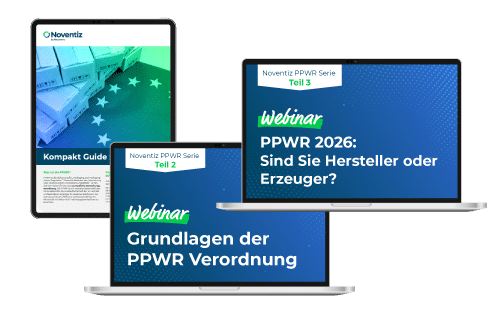
PPWR Infopaket (in German)
Recordings and slides of 2 PPWR webinars
- PPWR Fundamentals Webinar
- Related: producers & manufacturers
+ Additional PPWR Kompakt PDF
How does Noventiz help businesses to implement the PPWR?
Meet PPWR requirements with confidence through Noventiz
The PPWR brings a wide range of obligations and challenges for businesses. We are here to help you meet those requirements. Our bespoke services are continually adapted to regulatory developments:
Stay informed:
Our webinars and the PPWR Update newsletter provide regular, free updates on the latest developments, deadlines and practical requirements.
Check compliance, identify gaps:
In the PPWR Status Check, we work together to assess the current status, identify areas requiring action, and plan specific steps to ensure full compliance.
Manage your Declarations of Conformity efficiently:
The DoC Generator helps you to create, manage and store PPWR Declarations of Conformity.
Optimise recyclability:
rotate helps you to analyse and improve the recyclability of your packaging based on the recognised assessment methodology.
Our PPWR Webinar Series
PPWR One-Pager for Download
Anleitung
First steps towards PPWR conformity
Wissen
Article 5: Substances of concern/forever chemicals
Wissen
Article 11: Reusable packaging
Wissen
Article 38: Conformity assessment procedure
Wissen
Article 39: Declaration of conformity